
Research Projects
Here we present a selection of research projects carried out by our group, reflecting our collaborative approach to academic research and training across multiple disciplines and career stages.

Pasture to Plate
Our vision is to maximise the food potential of UK pasture by using targeted chemical processing and novel biotechnology to convert grass into nutritious edible fractions for healthier and more affordable alternative foods. This will help to make UK agriculture more resilient and sustainable.
Our proposal aims to use novel chemical processing methods to extract the central edible fractions from grass (protein, digestible carbohydrates, vitamins, lipids, fibre) before culturing the yeast Metschnikowia pulcherrima on the cellulosic fraction. Doing this will produce mycoprotein and a lipid suitable as a palm oil substitute.
We can then combine these ingredients in a range of alternative meat and dairy products, displacing environmentally damaging imported ingredients that are currently used. Further processing of the waste products from the process will produce nutrient rich fertilisers and help create a model for future circular farming economies. Learn more about the process (video)
Dry Powder Inhaler Formulations for Respiratory Infections
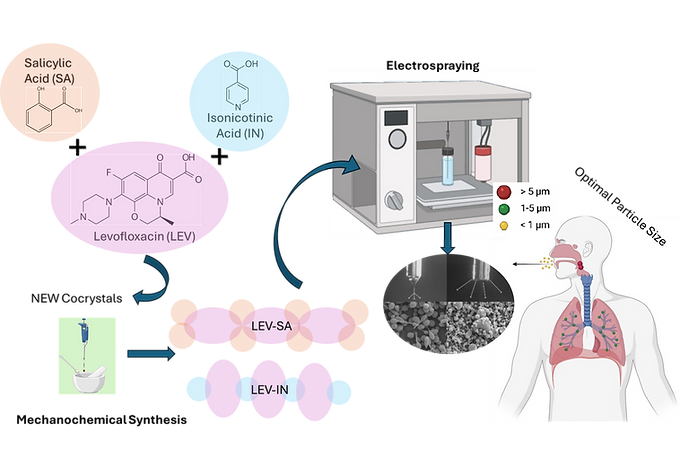
Our vision is to develop next-generation dry powder inhaler (DPI) formulations for the effective treatment of lower respiratory tract infections, using sustainable manufacturing approaches to improve therapeutic performance, accessibility, and patient outcomes. By combining pharmaceutical science with green chemical engineering, this work aims to deliver robust, excipient-minimised inhalable medicines with improved stability and bioavailability.
Our approach focuses on the design of advanced solid-state formulations using mechanochemistry and supramolecular chemistry to control particle properties, drug–drug and drug–drug interactions, and aerosolisation behaviour. In collaboration with Nanopharm, we integrate experimental formulation development with predictive tools to better understand structure–performance relationships and accelerate translation toward clinically relevant products.
Through this work, we aim to enable more efficient and sustainable manufacturing of inhalable therapeutics, reduce reliance on conventional solvent-intensive processing routes, and support the development of high-quality DPI products suitable for treating infectious respiratory diseases.

Machine Learning for Materials Discovery
Our vision is to accelerate the discovery and design of advanced materials by integrating chemical engineering with machine learning and data-driven modelling. By leveraging large chemical datasets and physically meaningful descriptors, this work aims to uncover structure–property relationships that enable the rational design of functional materials for pharmaceutical and separation applications.
Our research focuses on the development and application of chemical and molecular descriptors to guide the discovery of novel supramolecular structures in pharmaceutical systems, enabling improved control over solid-state behaviour, performance, and manufacturability. Building on this foundation, we are extending these approaches to the discovery and optimisation of membrane materials for a range of separation processes, including gas, liquid, and hybrid separations.
In parallel, we are using machine learning models trained on large chemical libraries to predict and rationalise chemical reactions and transformations, supporting faster screening of viable materials and processing routes. Through this work, we aim to reduce experimental trial-and-error, improve design efficiency, and enable more sustainable and intelligent materials development. Learn more (video in Spanish)

Chemometrics, Digital Twins and AI-Enabled Process Control
Our vision is to enable intelligent, robust, and adaptive manufacturing processes through the integration of chemometrics, process analytical technologies (PAT), and artificial intelligence. By combining real-time sensor data with modelling and data-driven analytics, this work aims to improve process understanding, control, and reproducibility in complex manufacturing environments.
Our research focuses on the use of spectroscopic techniques, including Raman and FTIR, as in-line and at-line sensors for monitoring material transformations during processing. We have applied these approaches to the control of extrusion processes and additive manufacturing platforms such as 3D printing, developing models that link spectral signatures to material properties and process performance.
Building on this, we develop digital twins that couple experimental data with physics-based models, including computational fluid dynamics (CFD) and process modelling. These digital twins enable physics-informed machine learning frameworks that combine mechanistic understanding with real-time data, supporting predictive, adaptive, and autonomous process control.
Through this work, we aim to reduce process variability, enhance product quality, and support the transition toward smarter and more sustainable manufacturing systems.

Membrane Technology
Our vision is to advance membrane-based separation technologies through the design of high-performance materials and scalable manufacturing strategies for gas separation applications. By integrating materials science, process engineering, and modelling, this work aims to deliver efficient, selective, and robust membrane systems for energy, industrial, and environmental applications.
Our research spans a range of membrane platforms, including palladium-based membranes for hydrogen separation, mixed matrix membranes that combine polymers with functional fillers, and advanced polymeric membranes for gas separation. We focus on understanding and controlling structure–property–performance relationships, from material synthesis and processing to module-scale operation.
To support rational membrane design, we combine experimental characterisation with modelling approaches, including transport modelling and process-level simulations. This integrated approach enables the optimisation of membrane performance, stability, and scalability, and supports the development of next-generation membrane technologies for efficient and sustainable gas separation processes.

Plastic Depolymerisation and Circular Materials
Our vision is to enable a circular approach to plastics by developing efficient, selective, and scalable depolymerisation strategies that transform plastic waste into high-value chemical building blocks. By integrating chemical engineering principles with innovative processing routes, this work aims to reduce dependence on virgin petrochemical feedstocks and support more sustainable polymer value chains.
Our research focuses on mechanochemical depolymerisation and reactive extrusion as solvent-minimised, energy-efficient routes for breaking down polymer chains. Through the application of mechanical forces, controlled thermal inputs, and tailored reactive environments, we investigate how polymer structure, additives, and processing conditions influence depolymerisation pathways, selectivity, and product distribution.
To support translation and scale-up, we combine experimental studies with process modelling and data-driven analysis, linking molecular-level transformations to reactor- and process-level performance. This integrated approach enables the design of continuous depolymerisation processes capable of recovering monomers and functional intermediates suitable for reintegration into new materials, contributing to the development of circular and resilient plastics systems.